Thursday, January 20, 2011

San Gervasio, revisited

      
image
      Known as the Island of Swallows, the island of Cozumel was a Mayan holy ground dedicated to Ixchel, the fertility goddess. Just a few miles outside the main town on the way to the "wild side" is the archaeolgical Mayan site of San Gervasio. Marie and I spent an hour here one late afternoon early this month while staying at my my sister's casa, walking about the ruins and gazing upon five distinct periods of Mayan construction. Before us were ruins from the Pre-Classic of 500BC to 200 AD through the Early-Classic (200AD - 600AD), the Late-Classic (600AD - 1000AD), the Terminal-Classic (1000AD - 1200AD) to the Post-Classic (1200 - 1650AD). It was during the Post Classic time period San Gervasio become one of the main pilgrimage centers of Mesoamerica. San Gervasio was also a place of intense trade, becoming the religious and administrative center for all of the island.


Entrance to San Gervasio, Cozumel, Mexico
 
Iguana, San Gervasio

The Murcielagos (Bats Structure) was the most important building in San Gervasio during the Late-Classic since it was the principal center of the site. The casa Grande Nohoch Nah or Big House was a temple that used to have an altar in the middle of the structure. The entire building was stucoed and decorated with red, ochre and blue colours.  I found two large iguanas sunning themselves on the warm stone and even when I approached them they did their best to ignore me - perhaps they were the reincarnations of some long lost Mayan warrior...

Murcielagos, bat structure

Casa Grande Nohoch Nah

El Arco

The Arch (El Arco) in preHispanic days was the entrance and exit of the central part of San Gervasio to the coastal site.

Hibiscus, San Gervasio
   Mayan women used to make a pilgrimage from the mainland to visit the temples and many statues of Ix Chel found here. The architectural style appears to be modeled after the capital of the Itzas, with the white stone roads connecting all the temples, similar to the roads found at Chichen Itza, another place we never had time to see on the mainland. While this site is pretty small compared to the giant sites on the mainland, it presents an interesting history of the Mayan presence on the island of Cozumel. There were few people about when we were there and it was peaceful and quiet. At the end of a busy day we found it easy to roll back the centuries and feel the presence of this lost time. gws


Wednesday, January 19, 2011

Faro Celarain, revisited


   When Marie and I spent four days on the Mexican island of Cozumel this past month we made a point of visiting Faro Celarain and the Punta Sur area on the southern tip. Mike and Carolyn had insisted we go there and it was well worth the short drive. There is an Ecological Reserve there which encloses a variety of natural wonders, covering an area of 1000 hectares - coastal dunes, mangroves, reefs, lagoon systems and beautiful beaches. The park is huge so our little rental car from Isis came in handy to drive from spot to spot within the park. We paid an entrance fee of $10US per person and got wristbands for the day. We saw the old lighthouse, small Mayan ruins (the Tumba del Caracol) a site dedicated to Ixchel, the jaguar goddess of midwifery and medicine, and a crocodile lagoon with a few sleepy inhabitants (we climbed the tall observation tower where it was easy to spot both crocodiles and their prey. As well as the crocs we saw herons, egrets, and off in the distance many pink flamingoes). We also passed a quiet beach sanctuary for sea turtles who arrive annually to lay their eggs. In the reproduction season beach surveillance is conducted by the Mexican army as well as people of Cozumel who care about the turtles. We snorkeled at the public beach, the water clear and warm, but until one went out to the reef very little life could be seen. Hurricane Wilma in October 2005 did a lot of damage to the region when it passed over Cozumel with winds peaking at 230 km/hr (145 mph), and alot of the coral was destroyed. We walked a short distance down the beach and, as you can see from the photo, had it all to ourselves! Just outside the park we stopped for cold coconut milk and bought some Mexican jewellery at one of the many vendors you'll find alongside the roadways. Thanks again Mike and Carolyn for the great suggestion! gws


Decision, decisions...

  Marie and I are flying down to Florida on the 6th of February to visit with family and bring back our 30 year old camper van Christina and I drove down last fall. In the meantime, knowing full well the old girl is getting long in the tooth ( the van, not Marie ), we have been looking at new and used trucks and truck campers to replace it when the time comes to put it down. I found this one that would remind me of the old van whenever we camped and the price is good....


....but I think Marie might be more comfortable with something like this. What do you think?


Decisions, decisions....gws

Tuesday, January 18, 2011

Museo Nacional de Antropología, revisited

                            Courage and confidence before the future
                          find the peoples in the splendor of their past.
                      Mexican, behold yourself in the mirror of that greatness.
                       Verify here, stranger, the unity of the human destiny.
                   Civilizations go by, but in the mind of men will remain forever
                        the glory that others have striven to create...
                                                                                        Jaime Torres Bodet


   One of the highlights of Marie and I's recent trip to Mexico was the opportunity to visit the National Museum of Archaeology (Museo Nacional de Antropología) in Chapultepec Park, Mexico City with Cesar, Phil and Fernanda. It was here I saw for the first time the Aztec Calendar, or Sun Stone, which was the centrepiece for the museum's fabulous collection of Mayan, Aztec and Olmec artifacts. Historically, the Aztec name for the huge basaltic monolith is Cuauhxicalli Eagle Bowl, but it is universally known as the Aztec Calendar or Sun Stone. This is a colour representation, which may or may not have looked like this -
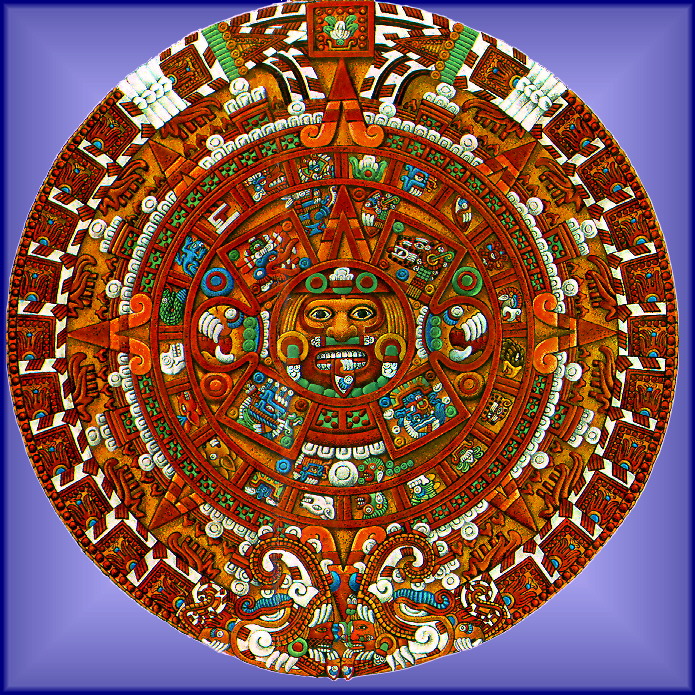
                              

   It was during the reign of the 6th Aztec monarch in 1479 that this stone was carved and dedicated to the principal Aztec deity, the sun. The stone has both mythological and astronomical significance, weighs almost 25 tons, has a diameter of just under 12 feet, and a thickness of 3 feet. It was carved from basalt - a solidified lava, this being an area where volcanos were common. Cesar and I stood under it and I didn't want to think what would happen if it suddenly decided to fall over...
 
Cesar and I, Museum of Archaeology, Mexico City

   On December 17th, 1790 the stone was discovered, buried in the "Zocalo" (the main square) of Mexico City. Afterwards it was embedded in the wall of the Western tower of the metropolitan Cathedral, where it remained until 1885. At that time it was transferred to the National Museum of Archaeology and History by order of the then President of the Republic, General Porfirio Diaz.

   A little bit of information you need to know to really appreciate this calendar - It was the calendar of the Aztec people of Pre-Columbian Mexico and shares the basic structure of calendars from throughout ancient Mesoamerica. The calendar consisted of a 365 day calendar cycle and a 260 day ritual cycle. These two cycles together formed a 52 year "century", sometimes called the "Calendar Round". The calendric year began with the first appearance of the Pleiades star cluster in the east immediately before the dawn light. Every month had its name, and the days of the month were numbered from one to twenty. The days of the last month, Nemontemi, were numbered from one to five.The box at the top of the stone contains the stone's year of creation, in this case 1479 CE. The first calendar of the Aztec people was called the xiuhpohualli, the counting of years. This was a 365 day year, helpful for planning farming and predicting the weather. There were 18 months, each 20 days long, or 4 (5 day) weeks.  Then to bring the year up to 365 days there were 5 "unlucky" days added (Nemontemi).  Each year would also be divided into 4 seasons. I found very interesting some of the ritualistic activities associated with each month. Children and slaves were particularily vunerable! Some examples ( I won't name the month, just it´s number ) - month 1: children were sacrificed to water gods, month 2: dances were held by priests wearing the flayed skin of victims, month 3: the flayed skins were buried along with more child sacrifices, month 4: the new corn was blessed with the sacrifice of maidens, month 5: any impersonators of major gods were sacrificed, month 6: impersonators of water dieties were sacrified by drowning, followed by ritual bathing and dances, month 7: more impersonators sacrificed ( not a good career choice! ), month 8: saw the feast for the godess of young corn, month 9: all the gods were festooned with garlands and feasts on corn-meal cakes and turkey commenced, month 10: ceremonial pole climbing competitions and sacrifices to fire gods by roasting victims alive began ( I assume they ran out of turkeys ), month 11: saw the sweeping of house and roads and mock combat, month 12: ceremonies welcoming gods returning to earth took place with much ceremonial drunkeness and sacrifices by fire, month 13: ceremonies for mountain rain gods with much human sacrifice and ceremonial cannibalism, month 14: featured a ritualistic hunt following a fast, then sacrifices of game and ceremonial feasting, month 15: began the decoration of homes and fruit trees with paper banners, a race-procession, and for those who just can't get enough - massive sacrifices, month 16: was for the festival honoring water gods, when children and slaves were sacrificed, month 17: magic was used to bring rain and women were beaten with straw-filled bags to make them cry ( beats being flayed alive! ) and month 18: images of god were made from amaranth dough followed by feasting on tamales stuffed with greens. The Nemontemi or empty days that were added were five unlucky days where there was no rituals performed and people generally fasted.
    Calender 2 was called the tonalpohualli. Though both calendars inter-relate in religion and ceremony, it's the tonalpohualli that is considered the sacred calendar. The rituals were all divided up among the gods. There were 20 signs, and 13 numbers. Like a gear within a gear, each of the 20 signs would be assigned each of the 13 numbers.  13x20=260, the total number of days in the "sacred year".  The 13 day period is a kind of Aztec week.  Not only was every day ruled by a god, each of the weeks were also ruled by a god - the one associated with the first day. Every 52 years, the two calendars would align. This could bring disaster on the world, so a special ritual took place called the New Fire Festival.

   No one really knows how the stone itself was used, but it may have been simply a monument or possibly a sacrificial altar. In the centre is the sun god, Tonatuih (some believe this may be the earth god). Each of his hands holds a human heart, and his tongue is a ritual blade for sacrifice. The four squares that come next show the four previous creations that perished (by jaguars, wind, rain and water). Next come the 20 signs mentioned above, the days of the Aztec month. The 5 dots are the 5 unlucky days, days of sacrifice. The next area has square sections with dots, possibly representing weeks of 5 days each. The eight angles are rays of the sun. Finally, on the Aztec calendar stone there are the snakes that come head to head together. The symbols may represent the 52 years in a cycle. Between the tails is a symbol probably showing the date the stone was carved. At the edge are 8 equally spaced holes. Sticks may have been placed in these, in order to use the calendar as a sundial.

   Other major highlights in the museum include a replica of the Aztec ruler Moctezuma's feathered headdress (the original is in Vienna); a stela from Tula, near Mexico City; massive Olmec heads from Veracruz; and vivid reproductions of Maya murals in a reconstructed temple. We didn't have enough time that day to see everything and I intend to return when I have the opportunity to explore more of these treasures. Here are a few more photos I took of our visit to this very impressive museum! gws


Marie, entrance to Museum


National Museum of Anthropology. Mexico City. Mexico (1566-385043 / V03-642496 © age fotostock)


Sunday, January 16, 2011

Log Homes


Marie putting on her snowshoes

  Marie and I headed out early Saturday morning for Lac Megantic to sign some papers for some land we purchased to the north of our property last year. We hadn't been there for a few months and had to pick up our mail that accumulates while we're gone and check out the cabin. It had snowed very recently and the Eastern Townships the other side of Sherbrooke were a winter wonderland, the trees heavy with snow and the mountains covered with what looked like icing on a cake. We parked at the bottom of our driveway and snowshoed in. I had wanted to see if the solar panel was covered with snow - which it was - and check the power level of the batteries. They were fully charged but until we get a thaw and the snow melts from the roof we are not going to be able to fully utilize the charging ability of the panel. We didn' stay long as we had an appointment with Timber-Block homes in Granby where we headed to after lunch, the promise of more snow in the forecast.
   Timber Block has been around for 30 years and is now expanding into the USA. We liked the way the company builds their log homes, producing R-30 insulated logs which utilize premium grade Eastern Pine; they combine these with a high-density polyurethane insulation which bonds the wood under extreme high pressure. The logs are then stacked, stained, bonded with 6,000 pounds of pressure and thru-bolted creating panels. We liked the Kelowna model and with a few modifications would provide the home we want.


We left after dark, the snow having arrived and slowly made our way back into Montreal. Today we are driving over to St Julie to visit with Modulex, another company that builds pre-engineered wood frame panelized homes. The sun is shining and we are both getting over the lingering flu symtoms! Life is good! gws

Friday, January 14, 2011

Teotihuacán revisited

highway 132 leading to the pyramids

                                                Walking down the Ave of the Dead

Tiny flowers growing in the ruins
 
Marie and tomb lining the Ave of the Dead

Me resting between two cactii, Pyramid of the Sun behind me
Fer, Rosio & Phil in front of the Pyramid of the Moon


This very important site we visited on Day 4 while in Mexico City, an hours drive north on highway 132. It was a hot December day and the sun beat down as we walked down the rough road leading to the Pyramids. It was an old place before the Aztecs arrived in the 13th century and had been long abandoned. Teotihuacán was one of the largest cities of the world during the first millennium C.E., when it had a population of 100,000 to 150,000. The pyramids were constructed around 150 C.E. and were abandoned around 600. Unlike the pyramids of Egypt, the pyramids at Teotihuacan aren't build of solid stone, instead they consist of stone and brick rubble covered with layers of cut stone, all done without the benefit of pack animals, metal tools or the wheel. Teotihuacán had lain in ruins for nearly six centuries when the nomadic Mexica tribes, the Aztecs, wandered into the Valley of Mexico. By their own accounts they  believed Teotihuacán to be the birthplace of the gods (in Nahuatl, Teotihuacán means "Place of the Gods"). In reality they probably knew little more about the site than we know today, despite nearly a century of excavation. When the Aztecs uncovered it from the thick growth that lay over it they used it for their own purposes, naming the two pyramids according to their own beliefs: The Pyramid of the Sun and The Pyramid of the Moon. The long main thoroughfare we now walked they called the Avenue of the Dead as they thought it was lined with tombs, which they were. The full significance of the Pyramid of the Sun only became clear to archaeologists in the early 1970s, when a tunnel was accidentally discovered at the foot of the main staircase. This tunnel led directly toward the center of the pyramid's base, where six chambers or caves were discovered. Originally believed to be natural springs, these "caves" are now known to be completely man-made, and to date back to the earliest date of the pyramid's construction. Excavations at the smaller Pyramid of the Moon have found burial sites - full of the remains of foreign warriors, mammals, reptiles and birds of prey. The victims were all ritually killed to consecrate each stage of the pyramid's construction. On the days of the fall and spring equinox, Teotihuacán is packed with people who dress in white and climb to the top. According to Cesar, who explained this to me, they stand at the top with arms outstretched to receive the special energy of the site on that day. The Pyramid of the Sun is nearly 200 feet high and 700 feet wide and with an estimated weight of three million tons! Since we have been there I have found out that because of the building method a lot of reconstruction was needed to get it to its current state, and there's alot of uncertainty about its original appearance as we saw it.


We climbed up to the top together - over 250 steps - and had some wonderful views. It is actually higher than a 21 storey building, and the altitude at this location makes it seem even higher! From our vantage point we could admire the surrounding countryside, the mountains and the Pyramid of the Moon.

 
Cesar atop the Pyramid of the Sun - don't back up!
Cesar at entrance to Quetzalpapalotl

 More drilling and excavations were being done at the Pyramid of the Moon so we didn't climb it but explored some nearby chambers (Quetzalpapalotl) decorated with panels still showing the vivid colours the Aztecs used. This is north along the Avenue of the Dead, on the left hand side just before arriving at the Pyramid of the Moon, and is the entrance to what is called the Quetzalpapalotl Palace. It's possible this was the residence of Teotihuacán's ruler: other living spaces are less ornate and generally divided into smaller areas. It is one of a number of former residences of the nobility which have been restored and made open to visitors. The name Quetzalpapalotl was originally applied to this place because the excavator thought he was uncovering depictions of a strange creature with quetzal bird and butterfly characteristics. More recently it has been realized that the creature was none other than the Teotihuacán armed bird seen everywhere. There are many painted and carved designs of abstract geometric figures in this palace; like other ancient American peoples, the builders of Teotihuacan were extraordinarily skilled at observing and predicting astronomical events and accurately recording the passage of time. We needed a break though and it was cool inside the chambers and a nice respite from the hot sun. I found it incredible that so much of the rich red, yellow, blue and green has survived in such a damp environment, especially since the surrounding buildings don´t provide much protection. There was also a sign directly above this mural saying "no flash " (which I honoured as you can see from my pictures), the screen in front had not been drawn, and sunlight was falling directly onto it, so if you want to see these murals before they fade now is the time! 

Sign leading to tombs - click picture to read


Detail of wall painting

Outside La Gruta

Inside La Gruta

  When we left we were thirsty and hungry and the chilly dim La Gruta restaurant, just a few hundred yards away, had cold beer! It is located in a deep cave, but the brightly colored furniture, table linens and candles really make the space burst with life! A nice way to end an afternoon of exploring! gws

Thursday, January 13, 2011

The Beach in Cancun


We are slowly getting back to normal here in Montreal, the recovery from the flu steady but unmiraculous. Marie has shown signs of improvement while I stutter along and wonder where the heck the past week has gone since our return from down south. The weather here has been great though and winter seems to be in hiatus while the rest of the country and the eastern seaboard are getting dumped on. That's fine with me as we plan to take a drive up to the property this weekend and check things out - it has been almost three months. Phil and Fer, the newly married couple in the apartment below us, we see often but are both busy and seem to be enjoying their new status. They took in the Canadiens-Penguins game last night at the Bell Centre and, much to Phil´s delight, Pittsburgh won handily. Meanwhile the city bustles and hustles about us, thoughts of spring really not that far off after all, visions of the beach in Cancun, early in the morning, still floating about amongst my weary brain cells...peace and love and enjoy the photos I took of the beach in Cancun!! gws


Sunday, January 9, 2011

Mexican Flu!

Ouch! I got bit by the bug last week in Mexico and have been out of circulation for a few days now. Hopefully I will be back on my feet soon. In the meantime don't forget to get your flu shot!!  gws

Thursday, January 6, 2011

Day 17 and 18 Cozumel/Montreal


                                                      Casa Vista Azul

Cancun Airport

All good things must come to an end! We left Mexico yesterday after spending our last day at a beach near Cozumel, enjoying the beautifully warm waters of the Caribbean sea and catching up on some reading. We had a farewell supper with Mexican wine and watched the sun set one last time, then early to bed to get up and catch the 7am ferry back to Playa del Carmen, grab a taxi to the airport in Cancun where we met up with Phil and Fernanda. We took American Airlines to Chicago after a 4 hour wait at the airport, changed plane at O'Hare for a small puddle jumper to Montreal and got home around 2am, exhausted, but ready to do it all again! Thanks to all the wonderful people who made this such a memorable trip! This coming week I will put down some thoughts and add more pictures of our time in Mexico, some sites we visited and a bit of the history and culture we discovered. Till then, again Feliz Ano Nuevo! Que la paz y la prosperidad prevalezcan durante el 2011!  gws

Monday, January 3, 2011

Day 15 and 16 Cozumel


Marie and I want to wish everyone a Happy New Year from sunny Cozumel! We arrived on Saturday, January 1st, after a wonderful New Years party in Cancun with all our new friends and family. We said goodbye after promising to visit soon and headed out by taxi to Playa del Carmen to catch the ferry across to the island. Cozumel is a small place and it was nice to be on our own for a few days at Carolyn's fantastic casa! Thanks sis! We rented a car yesterday and toured the island, visiting the beach at Punta Sur where we snorkled and saw the crocs, then drove over to the wild side - we had the place to ourselves most of the day and it was heaven! Stopped for cold coconut milk and even visited some Mayan ruins. Today we are going to explore the town and chill for one more day before heading back to Canada tomorrow.I'll be posting some more pix when we get home. Can't wait to come back!  gws